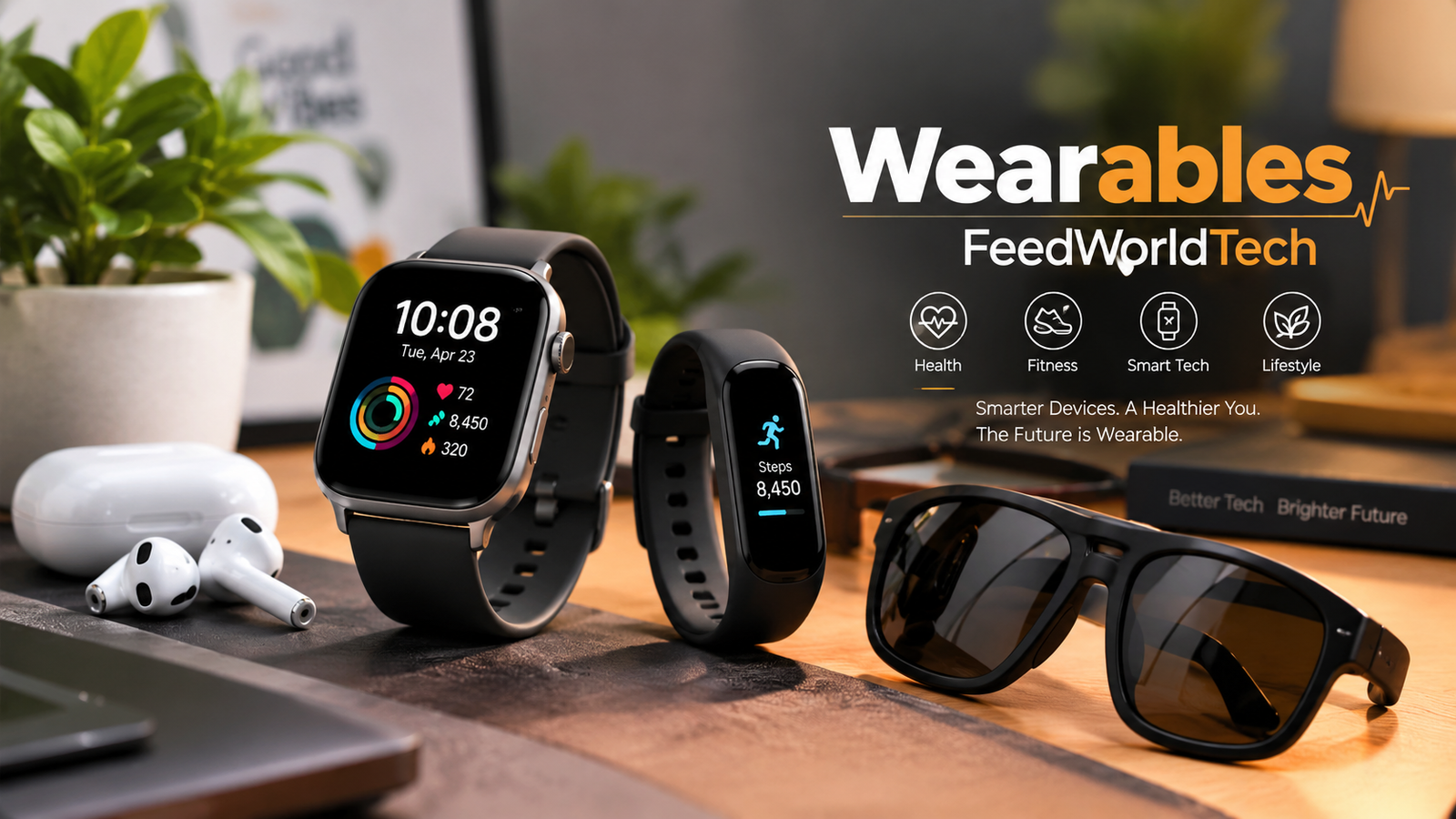
Wearables FeedWorldTech: Two kinds of readers arrive through a “wearables FeedWorldTech” search. One wants to know what this site publishes about smartwatches, rings, and health trackers. The other wants to know whether those articles are solid enough to act on. Both answers fit into one sentence: FeedWorldTech works as a general-audience explainer, which makes it a reasonable orientation tool and an unsafe final authority for anything touching health measurement.
One Name, Several Domains
Wearables FeedWorldTech presents itself as a technology resource spanning wearables, artificial intelligence, cybersecurity, software development, and digital transformation, written for professionals, students, and everyday readers. Its wearable pages run through smartwatches, fitness trackers, health monitors, and smart glasses, and describe devices logging heart rate, sleep, activity, stress, and blood oxygen. FeedWorldTech runs a comparable blog archive whose categories lean toward general tech news and explainer roundups. On the pages reviewed in September 2026, neither site displayed a named author byline, an editorial policy, or an ownership disclosure — a gap that matters more here than in most tech niches, because device functionality sits one step from a clinical decision.
An outside assessment lands in a similar place, describing the operation as a consumer-facing explainer blog rather than a research outlet or product-testing lab, with thin citations and little original reporting. A separate page that presents itself as describing the platform — a stated partnership with a companion explainer site, and a self-described analyst background — is the publisher’s own account Tech FeedBuzzard. Read it as a claim, not verification.
What the Wearables Writing Gets Right, and What It Skips
The directional coverage holds up. These articles capture the shift from step counting toward continuous monitoring, the role of on-device analytics in personalizing readings, and the mainstreaming of wearables beyond fitness enthusiasts. For someone new to the category, that is useful scaffolding.
The same assessment identifies what never appears: device-to-device comparisons, battery figures, accuracy data, privacy terms, named models, and price tiers. Those are exactly the details a buyer needs. Learn the shape of the category there, then move.
How to Judge a Wearables Source
| Check | Reassuring sign | Cautionary sign |
|---|---|---|
| Authorship | Named writer with a stated background | No byline, or a generic admin account |
| Evidence | Links to FDA documents or peer-reviewed studies | Assertions with no citations |
| Device specificity | Model, sensor type, test conditions | “A popular smartwatch” |
| Dates | Time-sensitive claims carry a date | Undated “latest” claims |
| Vendor language | Manufacturer claims separated from independent tests | Marketing copy restated as fact |
| Corrections | Updates and fixes noted | Silent edits |
The Facts Worth Carrying Into Any Wearables Article
Wearables FeedWorldTech: Regulatory status is the first filter, and explainer content usually skips it. The FDA’s general wellness guidance, revised in January 2026, keeps low-risk wellness products outside device regulation, while products that target the diagnosis, monitoring, or management of a disease fall inside it. The agency has also stated it has not authorized, cleared, or approved any smartwatch or smart ring intended to measure or estimate blood glucose values, and it has issued a safety communication warning consumers away from unauthorized blood pressure devices.
Accuracy research is the second filter. A 2020 study in NPJ Digital Medicine found consumer optical heart-rate sensors reasonably accurate at rest but markedly weaker under motion, and a 2024 living umbrella review in Sports Medicine continues to track how few commercially released wearables have been properly validated. Read that as a statement about conditions, not a verdict on brands. A claim that survives scrutiny names the device, the population, and the activity.
Market forecasts are the third. Analyst projections put the smart ring segment on a steep curve, with one estimate moving the category from roughly $519 million in 2026 toward $3.8 billion by 2034 — a projection about spending, not evidence that the hardware measures anything better.
| Form factor | Where it performs | Where it falls short |
|---|---|---|
| Wrist smartwatch | Wide sensor range; some cleared ECG features | Optical heart rate degrades during motion |
| Smart ring | Sleep and overnight recovery tracking | Fewer sensors; no display |
| Adhesive patch | Single-metric clinical monitoring | Limited wear time |
| Chest strap | Most dependable heart rate under exertion | Little beyond training data |
| Smart glasses | Ambient information and capture | Weight, battery, social friction |
A Practical Reading Routine
Before trusting any summary, check the FDA’s device databases or the manufacturer’s stated cleared indications for the feature in question. Decide whether a claim is a general-wellness statement or a regulated measurement. Look for study designs that name the comparison device and the activity tested. Handle privacy yourself, since the site’s wearables writing largely omits where sensor data travels — worth knowing before you wear something that logs overnight heart rhythms.
Questions Readers Ask
Does FeedWorldTech give medical advice? Nothing in the pages reviewed reads as clinical guidance. Treat health-adjacent articles as background, not direction.
Is it still worth reading? Yes, as a fast conceptual map. For a purchase or a health decision, pair it with manufacturer documentation and regulatory sources.
Why does the domain confusion matter? The name appears across multiple domains and social accounts, so confirm which site you are on before assuming one publisher’s output.
The Takeaway
FeedWorldTech’s wearables coverage earns a place in your reading list, not the final word. What it reliably supplies is orientation. What you still supply is the specificity: which sensor, validated how, under what conditions, and cleared by whom. Click here.